Chapter Eight: The MMP Election System
Mixed-member proportional: what is our electoral system and what does it do?

Image Credit: Electoral Commission
(You can listen to this article at this link.)
Section XXVII: Why Do We Have MMP?
MMP is a German system of government. MMP was introduced after World War Two. The goal of MMP is to prevent a single party racing to an extreme, taking full control of government, and doing whatever it wants.
MMP has succeeded, there and here, in practically eliminating one-party majority governments. Our parties have been tamed, and the diehards on each side of politics have abandoned our major parties to flee to smaller and weaker minor parties.
How does MMP get there? Once, Kiwis could only vote in their local electorate. How could minor parties stand a chance? They had to win more votes in an electorate than either of the major parties - already an enormous accomplishment - just to get a single seat. And because they never got their chance in Parliament, they could never prove themselves to win over more voters.
Voters were basically compelled to vote National or Labour if they wanted their vote to have an effect. From 1954 to 1987, the Social Credit Party always won over 5% of the vote, peaking at 20% - and never more than two MPs in Parliament.
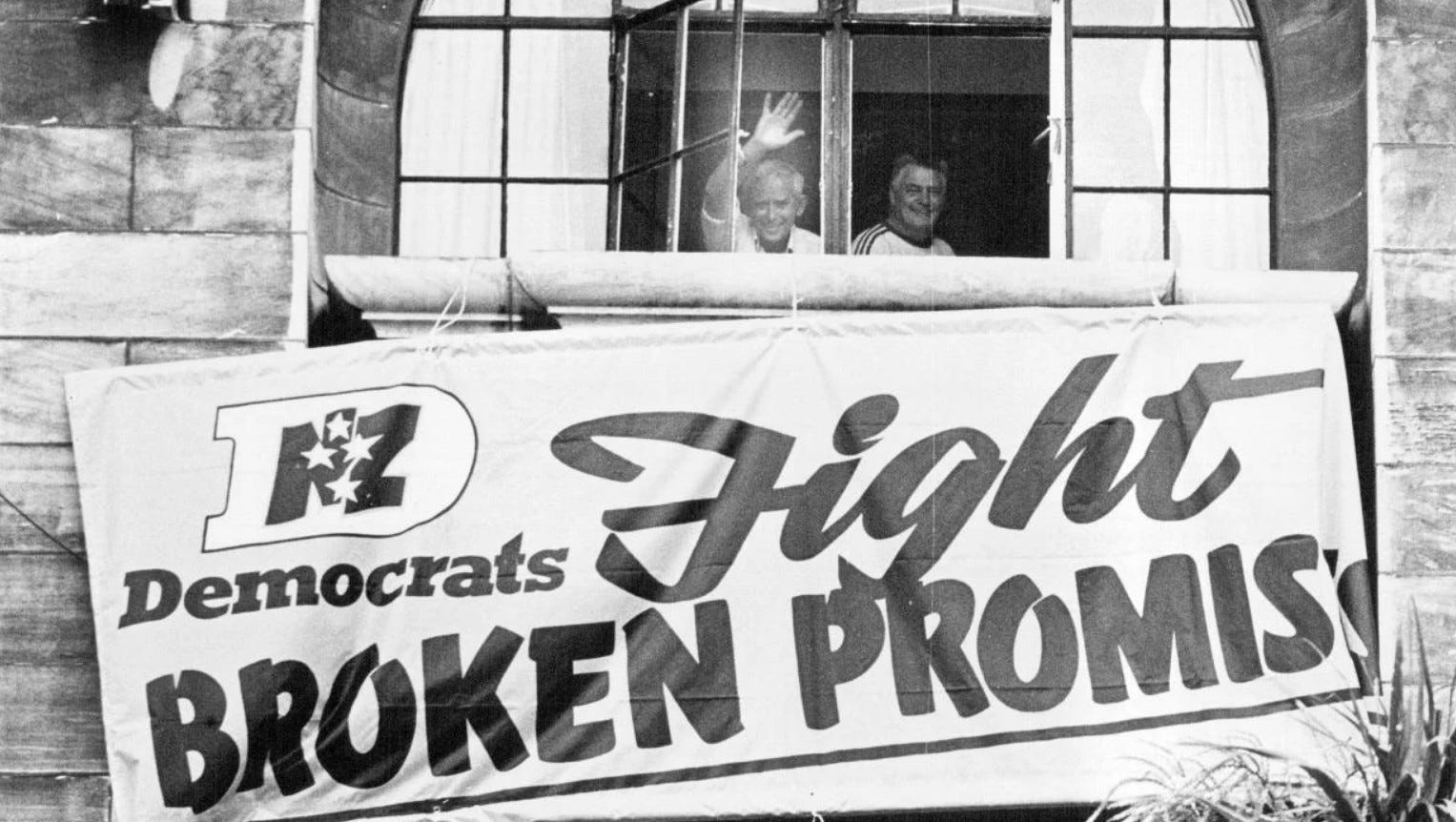
Image Credit: Staff photographer/Not-For-Syndication. Pictured: one of those luckless Social Credit MPs barricades himself inside his Parliamentary office with supporters to protest the system.
It was a ludicrously distorted system: minor party voters got no representation, while major party voters could hardly know what they were getting with how crowded their major parties became. Everybody from the right-wing libertarian Roger Douglas to socialists like Jim Anderton had to sit in the same Labour Party, just as Douglas’s spiritual successor, Ruth Richardson, was side by side in National with the arch-nemesis of Rogernomics, Winston Peters.
Little wonder the voters chose to sock it to the major parties by selecting MMP in a referendum.
So how do you vote under MMP?
Section XXVIII: Two Votes
MMP has preserved exactly the same electorate voting system to this day: if you win the most votes in your electorate, you are guaranteed to be your local electorate’s MP.
However, MMP now gives you two votes: one for an electorate, and one vote for a party. A party under 5% of party votes and with no electorates doesn’t get into Parliament; this has most notably been the fate of TOP, a party around 2% of the public supports, for the past three elections. Every party with at least one electorate or over 5% of the party vote gets into Parliament.
If a party already has a higher percentage of seats in Parliament than its share of the party vote, thanks to electorate wins, nothing changes for them; it simply keeps its electorate MPs.
If, however, a party has made it into Parliament, but its electorate MPs make up a lesser share of Parliament than its party vote, then they will be topped up until its Parliamentary caucus is in proportion to its share of the party vote.
Topped up with who?
Section XXXIX: The Party List
Before each election, each party is required to submit not only its electorate candidates, but also an order of parliamentary candidates. (Candidates can be on both the electorate and party list, or choose to only be on one or the other.) To top up a caucus, start with #1 on the list and work your way down, until proportionality is reached.
So, for instance, at the last election, the Green Party Party won 11.6% of the party vote. Therefore, they should receive 11.6% of the seats in Parliament, which rounds to 15 out of 120 seats. We go to the party list to recruit fifteen Green MPs, counting from #1 and working our way down:
Marama Davidson, who is not running in any electorate, gets in!
James Shaw, who is not running in any electorate, gets in!
Chlöe Swarbrick has already won Auckland Central electorate and does not get in by the list. If she had not won her electorate, she would get in by the list. If she had not been on the party list but did win her electorate, she would still get into Parliament and she would still count as one of the fifteen that the Greens are entitled to.
Julie Anne Genter also gets in by winning Rongotai electorate.
Teanau Tuiono loses his race in Palmerston North, but he gets in!
Lan Phan loses Banks Peninsula and is in!
Golriz Ghahrahman loses and is in!
Ricardo Menéndez March loses and is in!
Steve Abel loses and is in!
Hūhana Lyndon loses and is in!
Fa’anānā Efeso Collins loses and is in!
Scott Willis loses and is in!
Darleen Tana loses and is in!
Kahurangi Carter loses and is in!
You might expect one more list MP to come in here, but Tamatha Paul - who isn’t on the party list at all - has won Wellington Central, so instead she counts as one Green MP and Celia Wade-Brown, at #15 on the Green list, misses out.

Image Credit: Green Party of Aotearoa New Zealand
Do you see how revolutionary MMP is for minor party voters? Major party voters still get to have the biggest parties that lead the government. But before MMP, the Greens would have won 11.6% of votes and just three MPs, due to only winning three electorates, despite the public wanting them to have fifteen seats.

Edit Credit: Time’s Arrow me
Voters now have far more freedom to choose minor parties and still receive representation. Their electorate vote continues to matter by guaranteeing that the individual their electorate most favours WILL be in Parliament, regardless of what any party bureaucracy says. And that party bureaucracy can advance the best governing skillsets, even if they lack the retail politicking talents to win an electorate1.
How about changes during the Parliamentary term? If an electorate MP leaves Parliament, a byelection is held in that electorate only. That can lead to a different party’s candidate winning, upsetting proportionality. For instance, Labour was entitled to 65 MPs after the 2020 election, and National to 33. Labour MP Gaurav Sharma won Hamilton West. Two years later, he resigned. This caused a byelection in Hamilton West. Labour lost the byelection to National, so Labour fell below 65 MPs for the rest of the term, while National rose to 34.
Any time a list MP resigns, however, there is no need for a byelection and no damage done to proportionality. Instead, they are replaced by the next person on their party list. For instance, Golriz Ghahrahman resigned from Parliament just three months after the election, so Celia Wade-Brown replaced her. Of course, circumstances may have changed for somebody who was willing to become an MP at election time; if they decline, then the list simply passes on to the next person. For instance, if Wade-Brown had declined, then #16 on the list, Dr Lawrence Xu-Nan, would have gotten the call up, and so on. In this way, voters can check at any time who the “reserves” for their party are, just by looking up the most recent party list.
And that’s how your two MMP votes determine who makes up Parliament! Next time, we’ll cover the rest of the voting process: the physical reality of showing up and making sure your votes get cast.
The MMP era has also seen a much wider range of people come to Parliament: while Asian New Zealanders are massively underrepresented, Pacific peoples are well-represented, Māori are actually numerically overrepresented, and almost half of Parliament is female. However, the right-wing parties lag significantly in entrusting women and people of colour with positions of power: only one in three Cabinet Ministers are women (even lower if you include those outside of Cabinet), and the National Party has just a single Māori minister in Cabinet.